
Tastemap — Food Discovery
Find the plate, not just the place — dish-based discovery designed for two very different eaters.
Overview
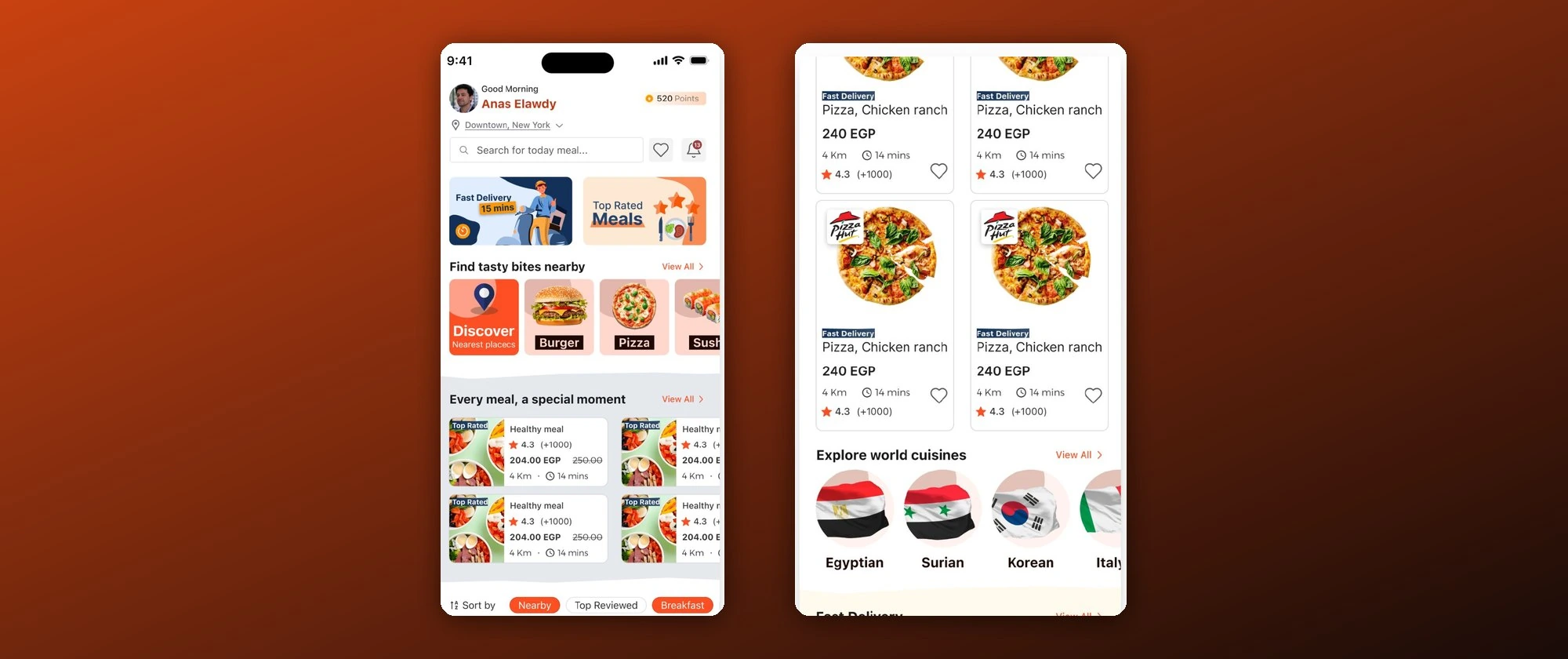
Tastemap is a food-discovery app concept that helps users find nearby meals and explore restaurants by dishes and reviews. The case study runs the full UX process: problem framing, How-Might-We ideation, two research-driven personas, competitive analysis of the Egyptian market (Talabat, Hunger Station, Marsoul, Waffarha), home-screen information architecture, an order-to-review user flow with a loyalty loop, a high-fidelity home UI, and a usability testing plan with tasks and metrics.
The Challenge
The redesign had to serve two conflicting personas at once — Omar the Quick Seeker, who wants a good, fast meal near him without browsing, and Layla the Explorer, who hunts the best version of a specific dish across the city. Too much detail slows the Quick Seeker; too little frustrates the Explorer. On top of that, dish-based search had no prominent entry point, and short, superficial reviews were eroding trust.
Our Approach
- 01
Frame the problems
Identified three problem statements: dish-based search discoverability, boosting review quality and retention, and resolving the conflicting needs of the two personas.
- 02
Ideate wide
Ran How-Might-We sprints per problem — a Smart Search bar with Dishes/Restaurants tabs, searchable dish tags from reviews, a guided review flow with gamified status, one-tap quick filters, and curated dish collections and food maps for explorers.
- 03
Learn from the market
Analyzed direct competitors (Talabat, Hunger Station) and indirect ones (Marsoul, Waffarha), extracting concrete moves: a Quick Meal function with dish tabs, context-aware ranking by time and location, and cards that show distance and delivery time upfront.
- 04
Structure and design
Defined the home structure — dual banners serving each persona, dish tabs, nearest-restaurant banner, and item cards with price, distance, and rating — then delivered the high-fidelity home UI with cuisine exploration and a fast-delivery rail.
- 05
Plan the validation
Wrote a usability testing plan: four tasks (quick meal in under 3 taps, discover a new cuisine, search a specific dish, write a full review) measured by completion rate, time on task, error rate, and satisfaction.
Tech Stack
Results & Impact
Gallery
YOUR INDUSTRY IS NEXT